Applying for a mortgage is not complicated once you know what lenders are actually looking at. In short, mortgage lenders review your credit score, your income and debts, your down payment, and your paperwork to decide how much they will lend you and at what rate. If you are a first-time buyer in Brenham or anywhere in Washington County, getting these pieces in order before you apply will save you time, stress, and often money.
My name is De Wayne Mortensen II. I am a REALTOR® with Better Homes and Gardens Real Estate Hometown, licensed in Texas (TX 836279) and California (CA 01749107), and I have spent more than 20 years helping buyers, including first-time buyers, navigate financing and closing. Here is what I want you to know before you sit down with a lender, whether you are shopping in Brenham, Burton, Chappell Hill, or anywhere in the surrounding counties.
What Credit Score Do You Need to Buy a Home in Texas?
There is no single magic number, but there are practical thresholds by loan type. Conventional loans, the kind most often used by first-time buyers, typically want a credit score around 620 or higher, and 3% down is available to first-time buyers through Fannie Mae and Freddie Mac. FHA loans allow scores as low as 580 with 3.5% down, or 500 to 579 with 10% down. VA loans have no official minimum, though most private lenders want 580 to 620. USDA loans, which work well for rural properties in Washington County, have no set floor, but lenders commonly look for around 640 or higher.
Remember that your credit score does not just decide whether you qualify. It helps set your interest rate. A higher score can mean a lower rate, and over a 30-year mortgage, even a quarter point can add up to a real difference in your monthly payment. Pull your credit reports well before you apply, check for errors, and give yourself time to address anything that looks wrong.
How Much Debt Can You Have and Still Qualify for a Mortgage?
Lenders use your debt-to-income ratio, or DTI, to measure how much of your gross monthly income goes to debt payments, including the new mortgage. Staying at or below around 43% keeps you in range for most conventional loans. FHA can allow ratios up to about 50% with compensating factors, and VA uses a combination of DTI and a residual income test, which checks that you have enough money left each month after housing and debts to cover everyday living costs.
The practical takeaway is simple: pay down revolving credit card balances, avoid taking on new car or furniture loans in the months before you apply, and do not run up new debt between pre-approval and closing. Lenders re-check your credit and your debts one more time shortly before closing, and a new monthly obligation can delay or kill your loan.
What Is the Difference Between Pre-Qualification and Pre-Approval?
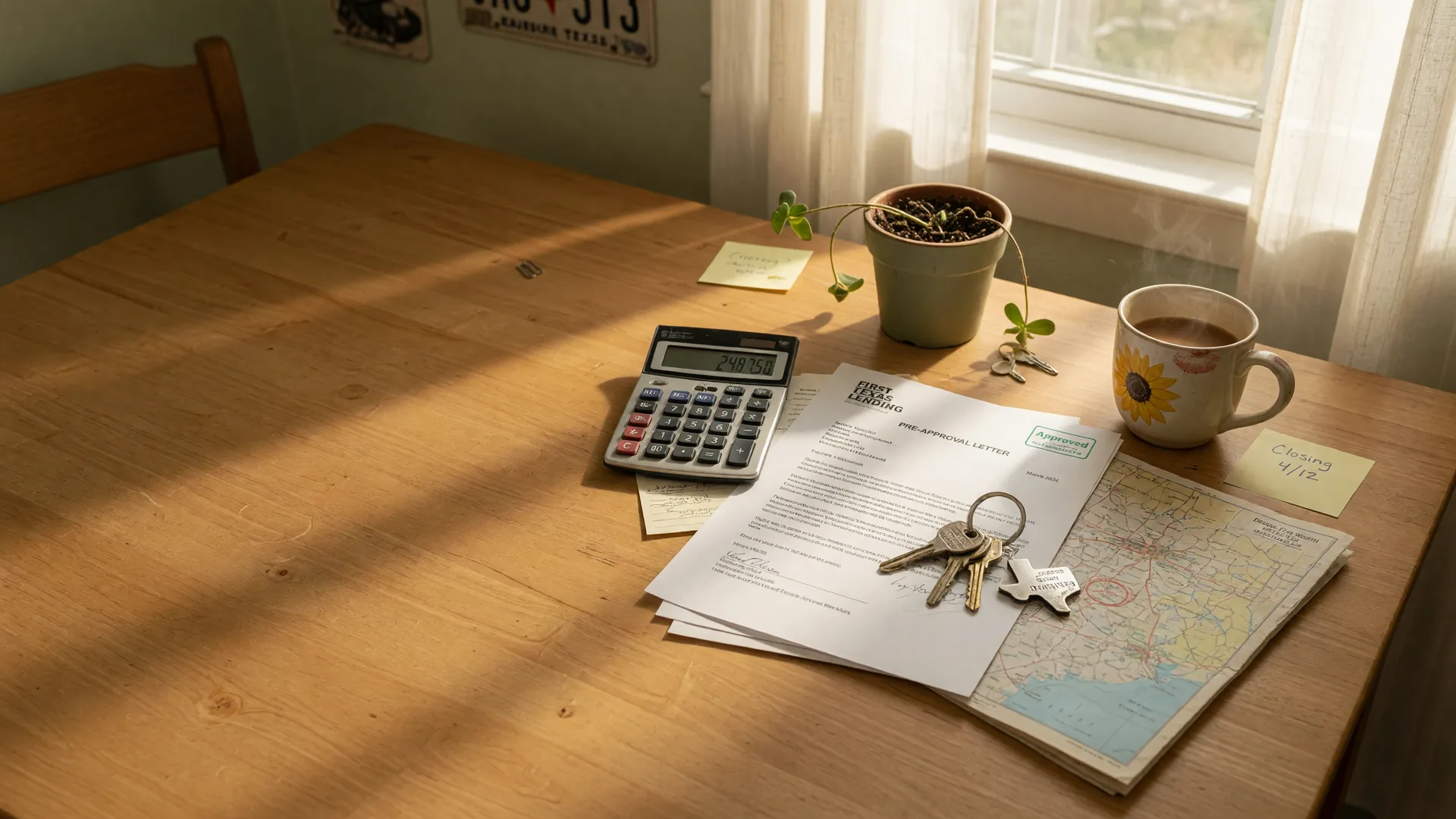
Pre-qualification is a quick estimate based on what you tell a lender, usually without a hard credit pull or document review. Pre-approval means the lender has reviewed your income, credit, assets, and documentation and issued a written commitment for a specific loan amount. It is the more serious of the two, and it is what sellers and their agents in Brenham expect to see with your offer, especially in a market where buyers may be competing for well-priced homes.
Because homes in the Brenham area are spending longer on the market than they did a couple of years ago, pre-approval also gives you an advantage: you can move quickly and write a stronger offer when you find the right property. It also tells you exactly what you can afford, so you shop in the right price range instead of falling in love with a home outside your budget,
How Much Do You Need for a Down Payment?
The old rule that you need 20% down does not apply to most first-time buyers. FHA loans allow as little as 3.5% down. VA loans allow 0% down for qualified veterans and active-duty members, and USDA loans allow 0% down for eligible buyers in qualifying rural areas, which includes much of Washington County. Conventional loans typically need 3% to 5% down for first-time buyers.
On a $300,000 home, 3.5% down is about $10,500. If that number feels daunting, know that Texas down payment assistance programs can cover part or all of a down payment for eligible buyers, so talk to a local lender who knows these programs before you decide you cannot afford to buy yet,
What Documents Will You Need When Applying?
Gather these before you meet with a lender: the most recent two years of tax returns and W-2s, your most recent 30 days of pay stubs, two to three months of bank statements, a photo ID, and documentation of any other income. If you are receiving a monetary gift from family, the lender will needs a signed gift letter confirming the money does not need to be repaid,
One tip that saves first-time buyers a lot of stress: avoid making large, unexplained deposits into your bank account in the two months before you apply. Lenders must verify the source of large deposits, and undocumented money can create delays at the worst possible time, right as you try to close,
What Programs Help First-Time Buyers in Texas?
Texas has several programs that pair with a normal first mortgage to reduce the upfront cost of buying. TDHCA's My First Texas Home program provides up to 5% no-interest down payment assistance for first-time buyers, and My Choice Texas Home offers similar help without the first-time requirement. TSAHC's Home Sweet Texas program provides 4% to 5% down payment assistance grants, and Homes for Texas Heroes offers 5% down payment assistance plus a mortgage credit certificate for teachers, first responders, medical professionals, and veterans,
Most of these programs require a credit score around 620 or higher, a primary residence purchase, income and purchase price limits by county, and completion of a homebuyer education course. They can be used with FHA, VA, USDA, and conventional loans. Requirements and caps change, and they vary by county, so I recommend working with a local lender who knows the current limits for Washington County before you get too far into your search,
What Mistakes Do First-Time Buyers Make When Applying for a Mortgage?
The most common mistakes I see are timing-related. Buyers wait until they have found a home before they talk to a lender, when the right move is to get pre-approved before you even start touring. Buyers apply without checking their credit reports first, only to discover errors or collections they could have cleaned up months earlier. And some buyers make big purchases, change jobs, or move money around between pre-approval and closing, which can put the entire loan at risk,
The good news is that each of these mistakes is avoidable. Treat the time before you apply as prep work: check your credit, gather your paperwork, get pre-approved, and then keep your finances steady until you close. In a market like today's, where buyers have more choices in places like Brenham and Washington County, being mortgage-ready means you can say yes with confidence when you find the right home,
Buying your first home is one of the biggest financial decisions you will make, and you do not have to figure it out alone. I can connect you with trusted local lenders, walk you through what to expect at closing, and answer your questions about schools, neighborhoods, and the Washington County market at every step. Give me a call anytime: I am glad to help,