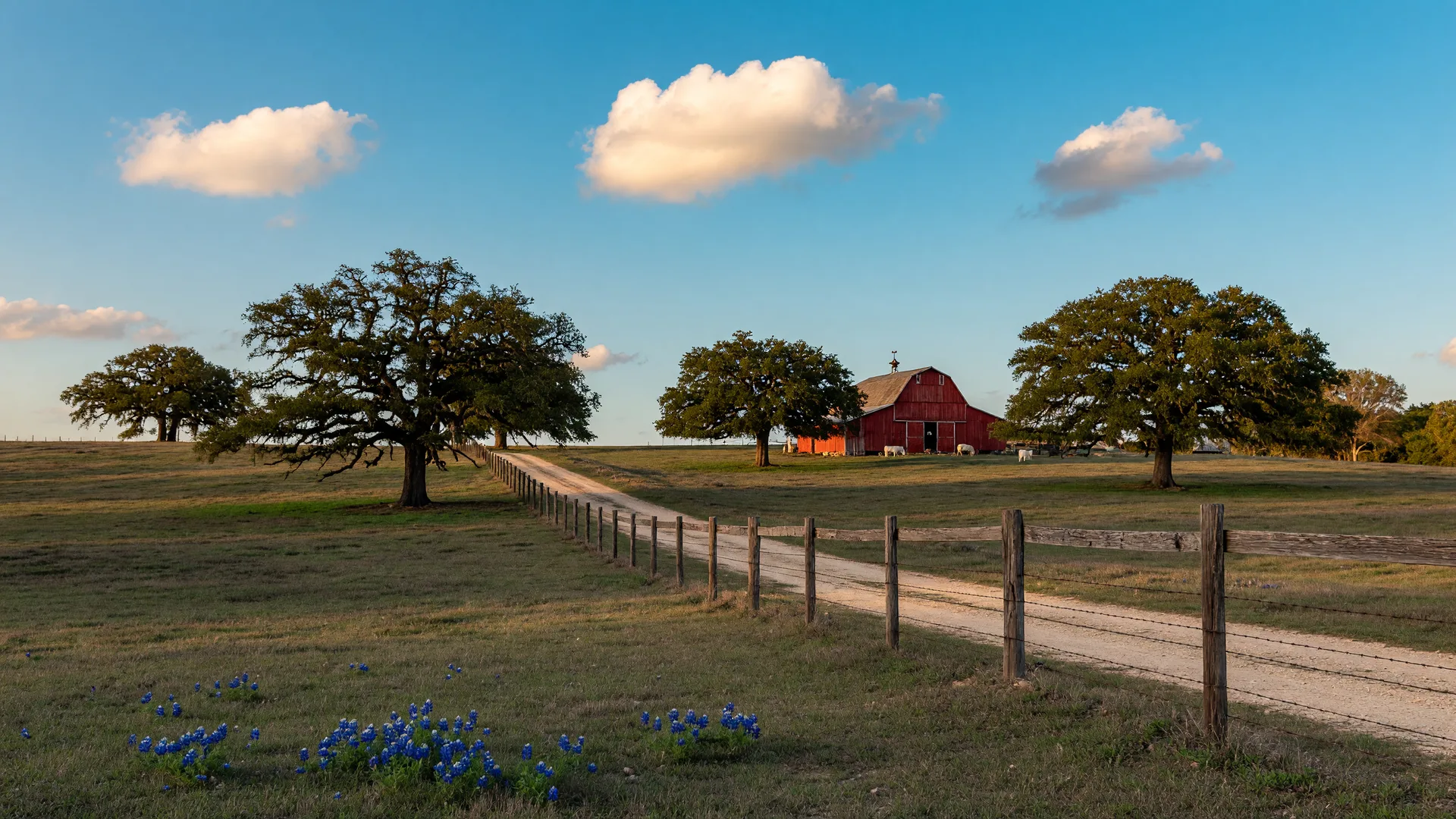
If you want the short answer first: current land listings in Washington County, Texas typically ask between roughly $35,000 and $46,000 per acre, with most available tracts running about 40 to 60 acres. Smaller improved parcels near Brenham, Chappell Hill, or Independence often ask far more per acre, sometimes $70,000 or more, because you are paying for the homesite, the trees, and the location along with the dirt. For context, rural land across Texas averaged about $5,200 per acre in late 2025, so Washington County acreage carries a clear premium.
My name is De Wayne Mortensen II. I am a REALTOR® with Better Homes and Gardens Real Estate Hometown, licensed in Texas (836279) and California (01749107), and I have spent more than 20 years helping buyers find and evaluate rural property in Washington County and across South Central Texas. Acreage is one of the most common searches in this area, and the same questions come up again and again: What does an acre really cost? What are the hidden costs? What should I check before I write an offer? Let me walk through the numbers and the practical details.
What Land Is Actually Costing in Washington County
Based on current listing data, most tracts of land for sale in Washington County span about 41 to 57 acres, with asking prices of roughly $35,000 to $46,000 per acre. Remember that these are asking prices, not final sale prices. What a tract actually sells for depends on location, soil, water, road access, improvements, the view, and whether the mineral rights convey with the surface.
Smaller improved parcels are a different story. A 6-acre home site with good trees and driveway access can list for $80,000 or more per acre, because buyers are really paying for a ready-made homesite rather than raw land. A 20-acre farm tract near Chappell Hill has listed near $71,000 per acre. If a property includes a house, barn, fencing, well, or pond, you are paying for those improvements, not just the dirt.
For statewide context, the Texas Real Estate Research Center at Texas A&M reported the average price of rural land in Texas at about $5,214 per acre in late 2025, up roughly 6.6 percent from a year earlier, with smaller lifestyle tracts under 50 acres selling for a median of around $10,200 per acre. Washington County's premium reflects its rich blackland soils, its bluebonnet-country scenery, and its position between the Austin and Houston growth corridors, all of which keep steady demand on land here.
What Different Budgets Typically Reach In This Market
These are general patterns from the market, not promises about any particular property. At the lower end, a buyer in the $200,000 to $350,000 range usually finds either a modest older home on one to five acres close to Brenham or an unimproved land tract further out. Mid-range budgets of roughly $400,000 to $700,000 tend to reach a comfortable home on five to twenty acres with some room for a shop, horses, or a small hobby farm. Above $800,000, buyers commonly look at improved 20-to-60-acre tracts, and full working farms and ranches can exceed $1 million.
The most practical way to think about acreage is not price per acre alone, but what you can actually do with the property. A $350,000 five-acre tract with a good well and a nice home site can serve you better than a $350,000 twenty-acre tract that needs a new well, a new septic system, and half a mile of road work. The land itself is only part of the cost of country living.
What to Check Before You Buy Acreage
Water, Septic, and the New Texas Water Disclosure
In Texas, groundwater belongs to the surface owner under what is called the Rule of Capture, but the practical question is whether there is an adequate water supply on your tract. Texas now requires sellers of rural property to complete a water disclosure form, a requirement that took effect on July 1, 2026, so review it carefully when it arrives with the title work. A private well should be tested for water quality and flow rate, and a septic design should be confirmed as feasible by the county. I cover these details in depth in my guide to wells and septic systems for rural buyers.
Mineral Rights
In Texas, the mineral estate is often severed from the surface estate, meaning someone else may own the oil, gas, and other minerals under your land even though you own the surface. Always ask whether the minerals convey with the purchase, and check the title commitment's Schedule B for oil and gas reservations. Buying acreage and later discovering the minerals were reserved decades ago is one of the most common surprises in rural Texas transactions, and it can be dealt with, but you want to know about it before you close.
Property Taxes and the Agricultural Exemption
A property used for qualifying agricultural or wildlife purposes can carry a much lower tax bill through the agricultural exemption, which is administered by the county appraisal district. The exemption is tied to the land's qualifying use, it does not automatically transfer to a new owner, and a buyer usually needs to apply and demonstrate the land continues to qualify. If tax savings are part of your plan, verify the exemption status with the county appraisal district before you rely on it. My guide to property taxes in Brenham and Washington County explains how this works in more detail.
Survey and Boundaries
Fences rarely sit exactly on property lines, and old surveys can conflict with neighbors' surveys. A fresh boundary survey is the only reliable way to know what you actually own, where the improvements sit, and whether there are encroachments or easements. For acreage, a current survey is one of the best uses of money in the entire transaction.
Soils, Drainage, and Flood Zones
Soil type determines whether and where a septic system can be installed, and drainage determines whether portions of a tract are buildable at all. Check the FEMA flood maps for mapped floodways or floodplains, because a floodway can make large parts of a tract undevelopable. A percolation or soil test and a quick flood check are standard due diligence on rural property, and they can save you from an expensive surprise after closing.
Land Use Rules and No Statewide Zoning
Texas has no statewide zoning, so what you can do on your land is governed by county regulations, subdivision deed restrictions, and utility or groundwater district rules. If you plan to keep horses, build a shop, run a short-term rental, or start an agricultural operation, confirm those uses are allowed before you buy. A beautiful tract with the wrong restrictions can turn into a disappointment quickly.
Financing Acreage Is Different From Financing a House
Every loan program has rules about land. Conventional loans generally allow a home on a few acres but place limits on excess land, agricultural income, or outbuildings. FHA loans typically require a connection to the home, and VA loans can finance acreage with a primary residence if the property meets VA minimum property requirements, including a safe water supply and a functional septic system. USDA rural loans can fit certain properties in eligible areas. Raw land with no home usually requires a separate land loan with different terms, larger down payments, and shorter amortization.
The practical takeaway: get pre-approved early with a local lender who regularly handles acreage and rural properties. A lender who understands well and septic requirements, mineral reservation clauses, and excess-land rules can tell you before you fall in love with a property whether it will finance cleanly.
Brenham and the Surrounding Communities
Washington County covers Brenham, Burton, Chappell Hill, and Independence, and I also help buyers across Austin, Brazos, Burleson, Fayette, Grimes, Lee, and Waller counties. Each community has a different character and price profile: established homes closer to Brenham's historic downtown, more land as you move out toward Chappell Hill and Independence, and everything from weekend-ranch country to working farms along the county lines. I have a full overview of these areas on my neighborhoods page if you are comparing one part of the county against another.
Common Questions About Buying Acreage
Is land a better investment than a house?
It depends entirely on your goals. Land does not produce rent, it carries ongoing costs such as property taxes, mowing, fencing upkeep, and insurance, and it is usually less liquid than a home. But a homesite you love and use every weekend has value that no spreadsheet captures. I never promise appreciation. What I can do is help you understand the market, the carrying costs, and the trade-offs so you can make a decision that fits your situation.
Can I use a VA loan to buy land?
A VA loan can finance acreage when it is bought together with a home that will be your primary residence, provided the property meets VA minimum property requirements such as a safe water supply and a working septic system. Raw, unimproved land by itself generally does not qualify for a VA loan. If you are a veteran or active-duty service member, confirm the details with a lender who knows VA loans on rural property, and I can point you to one. More on this benefit is on my military and veterans page.
Does the agricultural exemption stay with the land when I buy it?
Not automatically. The exemption is tied to a qualifying agricultural or wildlife use, and the county appraisal district reviews ownership, use, and eligibility. A new owner usually needs to apply and show the land continues to qualify. Always confirm current status with the appraiser before you budget around a reduced tax bill.
What hidden costs come with acreage?
Beyond the purchase price, budget for the survey, well drilling or repairs, septic design and installation, electricity and internet connection costs, fencing upkeep, road and driveway maintenance, mowing and brush control, higher insurance on outbuildings, and sometimes minimum-use charges from power or water providers. These items add up quickly, which is exactly why the financed amount is only half the conversation on rural property.
The Bottom Line
Washington County acreage is priced above the Texas average for good reasons: strong soil, beautiful country, and a location that keeps demand steady. The key to a successful purchase is checking the details that matter, water, minerals, survey, septic feasibility, taxes, and land use, before you commit. That is exactly the kind of problem solving I enjoy.
Whether you are looking for a few acres to build on, a small farm, or a larger ranch, I would be glad to talk through your goals and the numbers. With more than 20 years in real estate, including new-home sales, brokerage management, and plenty of rural transactions, I can help you evaluate a tract with clear eyes. Call me at 936-727-8820 or schedule a time to talk. Glad to help.